23 March 2022

Nude

So I turned 39 a couple of weeks ago, and the first thought that entered my head was, Shit how am I going to celebrate my 40th?!

A 47-year-old trainee said that she threw herself in a 40 Days of Skiing revelry. At that time, she explained, she was getting into this new hobby and it was a turning point for her. Cool. Not my style of "big", though. Can't see myself writing 40 poems, staging a 40-song recital, or eating 40 artisanal cakes.

It didn't take long for me to realize that I would love to do a nude photoshoot. I had wanted to do it before. In fact I did a half-nude version in 2002.

I was part of the college literary folio and one of the members had this bright idea to have a nude cover for our next issue. They asked me to model. No need to convince me, I was up for it. I liked myself, I liked them, I liked what we do.

In the end none of the photos we shot were approved by the organization adviser who will not be named in this post. I lost to Julie Lluch's Thinking Nude. A close-up shot of her sculpture of a woman examining her body in front of a mirror made it to the final copy of the journal.

The editors probably cared more about the rejection than I did. I got a copy of my photos and was very happy with them. Well, not all. There was a frontal shot I'd rather forget — I honestly don't know if a copy or the negatives still exist somewhere.

I framed two of my favorites and displayed it in my room. My mother got angry when she saw it and told me that I could showcase the pictures when I have my own house. I was surprised by her reaction, since I didn't do it out of malice or as a form of rebellion. But fine. It's now standing in my apartment's vanity dresser.

It wasn't until I was around 33 when I felt that my body was in its best shape. I couldn't wear shorts or a nice skirt in my teens and twenties because of a skin condition that I only got to solve when I started working and had the money to pay for a dermatologist. After that breakthrough, I also became more disciplined about exercising and my eating habits.

This affection grows as the years roll and my internal state is catching on. If you ask me, I am my most beautiful self — physically and internally — today.

A feeling of having been born is akin to the feeling of having been made. You're a clean slate yet somehow you are also complete. Inside, I am young. But when I look at the number, 3 - 9, 4 - 0, it's as if someone is telling me to be old. To act my age. How do 40-somethings act nowadays?

Rhetorical questions aside, last night's chat with my girl friends had me thinking about why I am open to being photographed nude yet I hesitate to send nudes to potential dates and partners (yes, I am conservative that way). Truth is I refrain from reading about nude portraits because I don't want to ruin the experience. I don't want to read any criticism of it. Because I can do it myself.

Schitt's Creek has this super relatable episode about Moira Rose and her leaked nude photos. Turns out there are no pictures of a young, vibrant, and naked Moira online. And she regrets it. We share the same impulse. Materialism (corporealism?) and vanity.

Part of me wants to preserve what I will surely lose in the future. Another part of me wants to flaunt what I've got. The nude portrait I have in mind may not be as profound a self-reflection as the woman in Lluch's artwork, but dammit I'll say it out loud: I want to be my own work of art — to be enjoyed by whoever cares to view!

Whereas "sending nudes" is meant to titillate, which is perfect in the context of dating or having fun, but again my conservative side would rather avoid it.

Happy 20th anniversary to my half-nude photos. Never thought I would love my present self way more than the 18-year-old girl whose back is turned against the observer.
21 March 2022

Piano lessons

Learn slow to learn fast.

Everyone will say this in one form or another, in passing or in depth. I'm quoting above the exact phrase said by the first piano teacher who first said it to me. It's the cliché that isn't because the more you play, the more you relearn its truth.

You can't make it if you can't hear it.

Fascinating how producing a sound is similar to writing. (As soon as I typed and reread that sentence it seemed so common-sensical!) A haze is in your head and you have to lock it into shape. Now once you go outside of your mind and put things down to words, the shape shifts into something else. Not wholly different but definite.

I am having interpretation problems with a certain section in my repertoire and my teacher advises creating a general story that would make sense throughout the entire piece. I get it, however I am a bit skeptical because I've had enough experience with creative people sharing the backstory of their work, and the theory and philosophizing are often way more interesting than the actual work.

A coherent narrative helps, though. Sure it will not register 100 percent from your mind's ear to your fingers and out the sound board (speaker in my case lol); and the fidelity goes much lower once it reaches an audience. Yet that is not the point. The point is you have an anchor to your act, a North Star to your journey and other such metaphors. I should listen to my teacher more.

Be an idiot.

There are no stupid questions. What we have is little time to ask all of them. My suggestion is to pick your most idiotic idea to discuss with someone else.

It also happens that we think we are super brilliant. So share your brightest idea to someone else and be open to disagreement.

The only place I'm devoid of any trust issues is in front of the keyboard. There is freedom in knowing I have no one to compete with in this discipline. That I won't be, I don't have to be, and I don't want to be the best here. Nothing is at stake. That's why it's easier for me, I guess.

I would participate in recitals and mess up and move on. My motivation undiminished.

I had a teacher who actually made me feel like an idiot and I moved on. My love for music and respect for teachers undiminished.

Oh wait, I joined a 'battle of the bands' in high school and I messed up the keyboard part in one of the songs. I made up for it in the next song. Heh. Good times.

I wish I could be as vulnerable in other areas of my life. Maybe I'll be as happy.

No one does it alone.

Even if solo piano is my vibe, I need at least a coach and an audience to be good and to be happy. Once in a while I feel a pang of loneliness. Sometimes it's a hunger for a thoughtful listener, sometimes a desire to play with others.

Back in my very first year of piano lessons, I was playing a short excercise piece and halfway through, my teacher, who was seated to my left started playing along. Normally I'd panic and would probably be so bothered that I'd stop. Something in the way she snuck into the music made me feel comfortable to the extent that I started enjoying myself.

Few moments had been as magical as that moment in the practice room.

10 March 2022

Poem 3, 2022

Birthday Line Breaks

Aphoristic couplet

I seem to have forgotten much of what I've done
Which really pretty much was none

*

Lyrical

I seem to have forgotten much
of what I've done
Which really pretty much
was none

*

Clever and deep

I seem to have
forgotten
much of what I've done
Which
really pretty

much was none

—Razel Estrella (16 February 2022)

09 March 2022

Cosmic waltz

Cracked open Volume 1 of Béla Bartók's Mikrokosmos (which I ordered at a music shop sometime in February) and I am loving it so far. Wonderful break from the repetitiveness of Czerny and the predictability of the common method book. Note: I adore Czerny and there is value in repetition, but I crave variety.

My favorite is Excercise 33, Slow Dance. The title is suggestive, plus it's in 6/4 time, so there are enough cues to make the job of teasing out the music easier.

But the key, I think, makes it special, makes the notes ring like a cosmic waltz.

*

And the word Mikrokosmos may be interpreted as a series of pieces in many different styles, representing a small world. Or it may be interpreted as "world of the little ones, the children".

—From the Foreward by Peter Bartók, son of Béla Bartók

I like this. I really, really like this variegated cycle of mini piano pieces. In each page I feel like a child for whom everything is a discovery.

*

Here's another exercise I enjoyed from the first book.

On to the next one—

04 March 2022

Poem 4, 2022

The Idea

Write down your ideas.

I did last night,
got out of bed and grabbed
a pen and paper and, like a child
chasing fireflies, caught
bright ends of a thought.

Sleep came quick
when my head hit cushion,
for a piece of my mind was safe
by the bedside table.
My body unburdened by the weight
of the unrecorded.

Morning arrived without flourish.
Neither the jolt of bad news.
Work was fine, the meals far
from sublime, small talk
and I was back to my room.

A glint
from the cap of a pen.

Ah, the idea.

Like a child hungry
for an endless gaze at her prized insect,
I hopped towards my conquest.
Two hands on either side of the page.
Eyes shifting
till they stopped in shock.

I got out of bed for this?

In front of me, before the red sun was my idea,
dry as a paper wing.

—Razel Estrella

16 February 2022

Tell me you're a narcissist

Recent events have compelled me to take a deeper, if not longer look into my relationships, which almost always mean confronting myself.

I've always had an inkling that I'm a narcissist, I just don't know what kind, to what extent, and how I've turned into one. I tick the grandiosity box. I believe I am empathetic but now I doubt if I truly understand the word. No way I am insecure — or am I?

Thinking led to googling, redditing, more thinking, more clicking link after link that eventually led to this video series.

There's my answer. Neglectful Narcissist.

Although.

Something doesn't sit well with me while watching the videos, despite the speaker being all credible: The whole assumption that the audience is the victim. I read the comments and everyone is like, That's my mother, father, wife, husband, et cetera. In my head I reply, You sure you aren't one yourself?

Am I what you guys call projecting? Confident that the next person is the same as me? Perhaps there are genuinely good people out there, only I couldn't see them with my blinders.

*

Edited to add:

Videos in the channel contain a disclaimer wherein it is noted that the information shared are solely for educational purposes and must not be taken as substitute for clinical care. Rest assured that I am aware of that when writing this blog and in moving forward.

14 February 2022

Poem 2, 2022

Girl

Wrist cheek lips and that
pearl at rest a heaving chest above
the heart a head crowned
with black braid and down

the dress flows like blue ternate
a leg shows a quick shine
then thighs veined
a polished toe a sway

of the hips the arms
hint of perfume small
as a whisper she enters
the onlooker's dream.

—Razel Estrella

28 January 2022

Poem 1, 2022

Prelude

Let's make work of beginnings.

Think prelude, how the masters
leave little worlds on their own
till one is found by accident
or plan by one willing Don or Donna.

What makes a prelude?

Length? 'Cause I hear of long and short,
a featherlight motif and rainclouds reprised.
Is it the promise that after this the music will roll
to no end

What do I make of this Opus?

A collection of beginnings, each complete
on its own, should stand together. My memories,
each like a book that in a shelf cannot stand by itself,
call for a master arrangement.

—Razel Estrella

24 January 2022

Prelude


Appropriate, to the level of cliché, that the first blog of the year features a prelude.

In TV-series tradition, a brief recap of 2021: I went back to taking piano lessons. End of recap. That's the only special thing that happened to me last year.

I forgot how demanding piano lessons could be. Enjoyable, yes, but having a teacher gives you this strong sense of accountability. Plus I'm paying for it, so to not practice is to waste hard-earned money.

Well it's not like I have to drag myself to study. The only challenge I'm facing is not having someone talk to about piano. Sure all my friends love music, from OPM to pop to classical (have yet to meet someone with a taste for budots, though); but I wish I have a fellow pianist to share experiences with — wins and frustrations.

There are online communities. Which I am a part of. Ah, I remember the days when I was so active at the universtity forum, I even attended "eyeballs". These are great, though it's hard to make a meaningful connection, especially if you can't regularly meet. But at least I have them.

Through piano-loving people from all over the world, I get to discover new music, learn things outside of my lessons, and have enough external motivation to keep me going.

One of the things we do is the weekly sight-reading challenge. The pieces are way above my level, but trying is what makes it fun. Connected to this, I've also gotten into the habit of recording myself, because I have no audience to speak of.

So let me slip this into your consciousness. My YouTube channel is currently seeing some action, since I'm dumping my practice videos there. Free cloud storage as they say.

No clue who'd be interested in viewing content that neither entertains nor educates. To be fair to me, I'll upload something decent, too. Like what I'm sharing here: Prelude Op 2 No 2 by Alexandar Scriabin, whose birthday is in January. It's a piece from the sight-reading challenge. I loved how it sounded, and it was rather easy in terms of the basics, so I gave it a bit more practice.

Here's to a year of continuous, however incremental, improvement, of beautiful music, and of having the pleasures of a thoughtful audience.

31 December 2021

Last lessons

Of the year, that is.

This morning a trainee and I were discussing legacy. Unable to articulate his thoughts, he shared a poem, which according to him encapsulates every Japanese's life-desire, including his.

Be Not Defeated By The Rain
Kenji Miyazawa
(Translated by David Sulz)

Be not defeated by the rain. Nor let the wind prove your better.
Succumb not to the snows of winter. Nor be bested by the heat of summer.

Be strong in body. Unfettered by desire. Not enticed to anger. Cultivate a quiet joy.
Count yourself last in everything. Put others before you.
Watch well and listen closely. Hold the learned lessons dear.

A thatch-roof house, in a meadow, nestled in a pine grove's shade.

A handful of rice, some miso, and a few vegetables to suffice for the day.

If, to the East, a child lies sick: Go forth and nurse him to health.
If, to the West, an old lady stands exhausted: Go forth, and relieve her of burden.
If, to the South, a man lies dying: Go forth with words of courage to dispel his fear.
If, to the North, an argument or fight ensues:
Go forth and beg them stop such a waste of effort and of spirit.

In times of drought, shed tears of sympathy.
In summers cold, walk in concern and empathy.

Stand aloof of the unknowing masses:
Better dismissed as useless than flattered as a "Great Man".

This is my goal, the person I strive to become.

(Via Kenji-World)

It's so funny, when he sent me the first English translation he found, he quickly dismissed it as bad, shook his head and searched some more. I couldn't identify the translator, but instead found many other translations. Most of them were similar to each other, and my trainee eventually chose a slightly improved version of what he initially sent.

A few more minutes of research led me to David Sulz's translation (quoted in full above). The longer lines, I felt, served the poem's prosaic diction well while providing a rhythmic flow. Simple, lofty.

Another writer, and another David — Novak this time, also "fiddled" (to use his word) with the Miyazawa poem. He called his work a loose paraphrase of Ameni Mo Makezu and an adaptation of Sulz's translation. His is more poetic in diction and structure, which doesn't mean that it's better. Though fun to read out loud, the tone borders on condescension.

There was a time when I wanted to learn Japanese, so I could read haikus in their orignal form, because I just knew that something great is lost in translation. Learning the language entails learning a new writing system, so I gave up.

I've been training Japanese professionals in Business English for three years now. On good days, I am convinced that I have demystified their culture. On bad days, I have demystified their beautiful cuture.

It's the last working day of 2021. Another trainee left a gem for me to keep in my mind's pocket. Not so much a discovery but a reminder. She says there is no such thing as luck. If anything, luck is a result of practice.

Keep writing, Razel, keep practising.

29 December 2021

Mikrokosmos

My little world, for a little while.

Something very pre-Covid happened last Monday: I commuted to and from Makati to have my hair-cut, shop, dine, and hate on the crowd.

It has been a solid 21 months since I've done that and boy, does it feel good.

*

Once upon a time, Greenbelt 3 was the place to go to if I would like to go book-shopping. Facing the road was the two-storey Power Books, where my university friends and I spent countless hours and cash on books and possibly coffee.

The book-store had evolved into a book-slash-office-and-school-supplies-store until it closed and was replaced by an H&M.

With its evolution and eventual demise, good literary books, especially poetry, have been a struggle to find; and somehow my excitement to hunt for rare gems in second-hand book shops have also waned. Finding gold that's dirt cheap becomes meaningless if that's the only option you have.

*

Another category of books in abundance during that time was music books: sheet music, method books, classical etudes, 'song hits' (lead sheet of popular music). These are close to extinct these days.

In my early years of piano lessons, I hoarded them. What the hell was I going to do with a complete collection of Chopin etudes? Nothing, but as hoarder mentality goes, I thought I might play it in the future.

Along with it, I bought Czerny etudes, which looked intimading back then. Guess what, I've been using Czerny 599 since I re-enrolled in piano lessons last September. Am now half-way through. Not so intimading anymore.

While I'm at it, I also have the complete score of Cats, because I just love the damned musical. As I gain confidence in playing, I mess around with a few songs every now and then.

Maybe I'll soon give a Chopin etude a go.

*

My heart leapt when I saw Béla Bartók's Mikrokosmos, because I didn't expect to see it.

Where I avoid a life of excess, books are a worthy exception. There will always be space and time for them.

Last Monday, I dropped by several book shops in the area, feeling hopeful. Being out and about is something I've missed. What makes me happier is that my appetite for book-hunting is back.

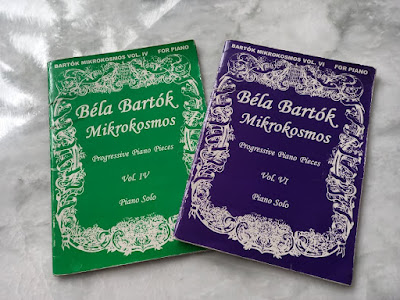
The long walk was rewarded. I found what seemed to be the last copies of Béla Bartók's Mikrokosmos volumes 4 and 6, as well as a beautiful collection of Kundiman (traditional Filipino love songs) transcribed for piano.

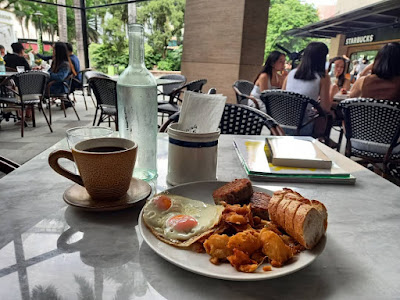
Eagerly I scanned them, but not before I settled at a nice café to enjoy lunch and unwrapping my books. The difficulties in each page, coupled with the understanding of what made them difficult, were sources of excitement. Same goes when I open a book of poetry or fiction. It all felt familiar. It all felt new.

*

I, too, sometimes have regrets about delaying things. If I had focused on writing more in my twenties, then I would've already published my very own book.

Those years, instead, were spent doing the things that I wanted to do when I wanted to do them: I went to graduate school and met some of my best friends, took piano leassons, learned to swim, somehow got into a conservatory, applied for jobs, quit them, earned, saved, invested, stared at clouds, drank vodka at the bar and pretended to like it.

No time was wasted. Although it appeared so due to a constant message of living a linear life-narrative. The moment I strayed from the part where we're supposed to fall in love at 16 should've been a clue that I am not meant for this brand of normalcy.

Neither is this pandemic taking away my zest for living despite everything it is taking away.

30 November 2021

Highlights from 'The Black Notebook'

Modiano, Patrick. The Black Notebook. Mariner, 2016.

My favorite bookstagrammer (is that how you call them?) told me that "[Patrick Modiano] has a very delicate way of painting nostalgia and memory." I only started to see that in the latter part of The Black Notebook.
"We're almost there," she said, "It's at the beginning of Rue Blanche..."

Last night, I dreamed that we were following the same route, probably because of what I had just written. I heard her voice, "It's at the beginning of Rue Blanche," and I slowly turned toward her. I said:

"At number 23?"

She appeared not to hear. We walked at a stready pace, her arm in mine.

"I once knew a girl named Mireille Sampierry who lived at 23 Rue Blanche."

She didn't react. She remained silent, as if I hadn't said a word, or as if the distance between us in time was so great that my voice could no longer reach her.

But that evening, I didn't yet know the name Mireille Sampierry. (p89)

For context, Mireille Sampierry is one of the aliases of Dannie (the girl in the dialogue), whom Jean (the narrator) is talking to.

Modiano has done this several times in the novel — mix the present with the past, real events with dreams; but here it stands out, as Jean, after so many years, begins to understand who Dannie really is. Starting with her name.

If only she exists in the present and not in Jean's memory.

That passage evokes the sensation of a vivid dream. In my experience, a bad dream is less heartbreaking, because waking up vanquishes it. A beautiful dream, however, where you could swear that you are laughing with your estranged friend, ends with the cold reality of it being just that — a dream.

*

Some underlined bits:

But Sundays, especially in late afternoon, if you are alone, open a breach in time. You need only slip into it. (p3)

Rather than always subjecting others to interrogation, it's better to accept them as they are, without comment. (p46)

Trinité Church, its dark façade like a giant bird at rest. (p89)

What a strange feeling, every time, when you learn things twenty years after the fact about people you once knew... You finally decipher, thanks to a secret code, what you had lived through in confusion and without really understanding... A car ride at night with the headlights off, and no matter how tightly you press your forehead against the window, you have no reference points. And besides, did you really ask that many questions about where you were going? Twenty years later, you follow the same path by day and finally see all the details surrounding you. But so what? It's too late, and no one is left. (p93)

Do we have the right to judge the people we love? If we love them, it's for a reason, and that reason prevents us from judging them — doesn't it? (p117)

31 October 2021

From acoustic to digital

The piano makes me happy, which means it makes me sad if I can't engage with it daily in some way — playing, practising, messing around — and at a level that allows me to utilise my brain and limbs to full capacity.

Joke goes that you know you're in a Filipino household when there's an unused, out-of-tune upright piano. My childhood home fit the stereotype. Except that we played it.

Filipinos my age would remember a time when basic music theory was taught in primary school. We learned so-fa syllables, the parts of the grand staff, and had to perform a simple tune by the end of the term. Mary Had A Little Lamb was the first entry in my humble repertoire.

That's about it with my formal music education from childhood to adolescence. I clung on to the little knowledge I had to teach my self further. I bought sheet music of popular songs at National Bookstore and painstakingly figured out the rhythm, identified the notes and typed them on the keyboard. When I graduated and started working, I saved — no, I allotted money for piano lessons. Commitment was effortless, that I've studied with the same teacher for two years straight.

I was the only one in the family who was serious about the instrument. So when I moved to my apartment, I brought the piano — a black, warm-toned Yamaha U1 — with me.

Prior to moving, I also changed jobs. It was more demanding, but also something I had always wanted: writing for a big publication. Still, the piano held its place in my life as an equally demanding but autotelic enterprise.

I continued to learn new pieces and improve my sight-reading; though I couldn't do a full-on practice, especially where technique and dynamics were concerned. The tenants in our townhouse wouldn't have it with the torturous scales, the endless repetition of an out-of-context bar slowed down to 30 beats per minute, worse, a wrong note in an otherwise elegant phrase.

Despite the playing, I felt silenced. The whole situation made me google hybrids, and that was pretty much it. I couldn't take another step to solving my problem as these hi-tech pianos are way too expensive, as if you're buying a brand new grand.

Locked at home, my sadness and itch to strike keys made me think about caving in to digital pianos. Music students use them, so who I am to be so picky?

The image that immediately came to mind was one of those slab portables used for gigging, and yes, those that fit snuggly into dorm rooms. I was happy to settle with that, also because I didn't have to burn a hole in my pocket.

Until a bit of digging — two or three more clicks down the DP rabbit hole — introduced me to the world of digital piano consoles. Me being me, I was drawn by appearance. They were beautiful. Function-wise, they had built-in covers and the pedals were secured at the bottom. Price-wise, I had to be creative in finding ways to pay for one. And me being me, I just knew that I had to get myself this piece of furniture that plays music. And get it I did.

It didn't take long for me to decide which digital piano to buy. Thankfully analysis paralysis wasn't part of the shopping experince as the choices available here were limited, and so was my budget.

With a short-list of models based on weeks of research and phone calls, I was thrilled to take a trip to the showrooms. This thrill tempered as soon as I pressed a single key. Customer reviews and even music professionals rave about how these brands and products "sound and feel like an acoustic piano". Totally untrue.

There was no give, no sensation of catching back what you've let go, no vibration.

But I was dead set on playing again and playing freely. So I didn't leave without purchasing a digital piano which had the best action, tone and, well, design.

Since the unit was delievered in August, I was playing and practising non-stop. And it didn't feel like I was making up for lost time. I was genuinely enjoying myself. Very quickly I learned that comparing a digital piano to a "real" aka acoustic piano is unproductive. The former is its own instrument — and is the instrument I need right now.

My interests are endless and fleeting, however, the piano has been a constant fixture in spaces I've decided to call home. I consider myself a forever-beginner. A serious hobbyist. Perhaps an advantage I should embrace. Seeing younger and better pianists than me is awe-inspiring. If this were my career, I'd be jealous and resentful (character flaw revealed), and hold back from enjoying their performance. On the opposite end, when I see a struggling self-taught beginner, I root for them.

Playing the piano is a pleasurable problem-solving activity for me. One where I easily slip into the zone, and once there, I have only my body to tell me when to stop. The practice provides a tangible feeling of success and improvement. And it gives me a sense of control.

In the real world, I do not exactly know whether I have done or been good or bad; and very few of its workings are within my control. It's insane the amount of money I've spent (and continue to spend) on lessons, accessories, books on top of the piano itself, a machine that keeps me sane.

15 September 2021

Venus and Mars in Aries 4th House

Everyday view from the kitchen window

You read your horoscope and think it can apply to literally anyone in the world. Then you go deeper into your birth chart, review house systems and find this:
Venus in the 4th House
Venus in the fourth house means that these people are the happiest in their own home, or that they would like to have an ideal home. These people have an emotional connection with their home. They love their house or flat and they try to make it nice and neat, often with real artistic talent.

Mars in the 4th House
Mars in the fourth house points to energy in the home of these people. They aggressively seek security... This position of Mars usually means conflicts in the household and family. People with Mars in the fourth house often avoid marriage. Sometimes it can mean a person who puts great efforts into building or rebuilding his house or who has a rather aggressive interest in his surroundings.

(Via Astro-Seek ; Whole Sign house system)

Holy shit. That it even uses the words 'flat' and 'aggressive' is ridiculous, because spot-on. My Venus and Mars are both in Aries, both in the Fourth House. We associate Venus with sexual attraction, Mars with desire and drive, and Aries with fiery possessiveness; but never have I thought of these energies manifesting in the material home. Yet it makes perfect sense to me.

I am over-protective of my space. Since 2014, you could say that I've been building another shell, a shelter (sorry, can't help it). All this time I've been adding and substracting articles, repairing parts of and beautifying this tiniest of flats. It's a never-ending process, too.

What's all the work for? I imagine entertaining. Oh the dinnerware sets I bought, the table for two — or more. A piano for my sanity and to serenade guests. Where my clothes are myself in public, my house is myself in private.

In both spheres, what I share remains minimal. Thing is, I rarely bring in anyone here. If my public persona is closed off, my apartment door is just as tightly shut. There is so much stress in cleaning up before and after visitors, and then the constant fear of someone breaking something. And to be honest, I don't quite know how to say, Hey, can you leave now? It's time for me to be alone.

13 August 2021

I learn to keep quiet

I learn to keep quiet so they'll think nothing and everything of me.

02 July 2021

Notes on 'The House of the Scorpion'

Farmer, Nancy. The House of the Scorpion. Atheneum, 2002.

Judging by the book cover, The House of the Scorpion by Nancy Farmer must be brilliant. The Newberry medal has always been a sound guide for me when it comes to picking out Young Adult fiction. (I don't 100% believe in awards, but they do serve some purpose.)

In the front cover is a Newberry Honor seal along with a National Book Award and a Michael L Printz Honor. I would've ignored these accolades, given the not-so-attractive cover art, and return the book to its place in the shelf, if not for the back cover endorsement by Ursula K Le Guin.

Farmer doesn't have Le Guin's evocative language and profundity (a comparison is uncalled for, but forgive my knee-jerk reaction). She does have an ambitious sense of scale, though, plus the ability to hold your attention with a good plot, pace, and enough characters to care about — and hate.

Writers are rarely successful in developing a character that would elicit varied emotions from the reader, or maybe they don't just try; but Farmer has done it and everything else so well that I am now on the hunt for the sequel, The Lord of Opium.

Some underlined bits:

She was overflowing with life. Everything delighted or devasted or fascinated her. (p 212)

Friendship was a pain, Matt thought. All these years he'd wanted friends, and now he discovered they came with strings attached. (pp 311 – 312)

Mi abuelita said I mustn't be afraid of skeletons because I carry my own around inside. She told me to feel my ribs and make friends with them. (p 351)

If you have read the book and would like to talk about that death, my socials are open.

18 June 2021

Punctuation

Am not returning this book. Joke/not joke.


My niece brought this book to my apartment and left it, that is, forgot to bring it back home, as she does with all the things she brings — toys, art, whatnot — during her visits.

Cowell, Philip (author); Hildebrand, Caz (illustrator). This Is Me, Period. Clarkson Potter, 2017.


It's a clever, playful book on punctuations, with a hint of sassy pedantry between the pages.

No one's too young for a semicolon or a William Blake reference.


I could see the little lovers of this book loving Lynn Truss's Eats, Shoots & Leaves once they're older and ready to read longer texts.

My favorite page.


By the way, a couple of weeks before I came across This Is Me, Period, one of my favorite podcasts, The Verb, released an episode on Pausing and Punctuation.


The punctuation gods compel me to ask, what are your most beloved references on grammar and punctuation?

09 June 2021

The Hollow

My Agatha Christie binge has extended into the small screen (of my 11-inch MacBook). Thanks to the good YouTubers of the world, I can now enjoy the British drama series Agatha Christie's Poirot. Naturally (for me, that is), I started with the episodes based on novels I've already read, thrilled to see how they are reimagined for TV.

The title I enjoyed most from my small Christie collection is The Hollow. I talked about the main character, Henrietta Savernake on the podcast, and here I'd like to discuss what really makes the novel great. To put it simply, it's how the characters are profiled.

Christie, Agatha. The Hollow. Berkley, 1963

Henrietta, for example, is introduced to the reader right smack in the middle of her work, while sculpting with a model. We are inside her mind, following her artistic process. We understand that she doesn't need the model to copy from but rather to inform her art. What she draws from the model — a stranger whom she convinced to sit for her — is something a casual observer would fail to appreciate.
None of the features were clearly defined. It was Nausicaa remembered, not seen... (p 12)
In that chapter, we can see Henrietta's dedication to creating art, as well as her detachment to the human being in front of her.

Then there's the chapter on Gerda, over-thinking whether to send the mutton back to the kitchen to be kept warm or to leave it on the table because her husband John might arrive any moment now.

The whole world had shrunk to a leg of mutton getting cold on a dish. (p 25)
Here we understand why people regard her as a slow-witted woman deeply devoted to her man.

There is also Lucy Angkatell and her tireless but never tiresome chatter. She's painted as someone who could do something completely bizarre (she has), and say something completely illogical (she does), yet you'll forgive her, at best ignore her.

The Hollow is a big house, and for a weekend where it's filled with colorful people, it remains that: hollow. Because somehow each of the guests has an emptiness in them. I'd been wondering, The Hollow is an odd name for a property. Suitable in our story, though.

A brief note on art. Henrietta sculpts. And I know that there's a reason why she is a sculptress. Later on, one of her pieces becomes a hiding place for an evidence. More than that, the crime scene itself is another one of her creations, however far from a masterpiece. She showed her hand, and Poirot catches this. As the saying goes, the best art conceals itself.

These character sketches and intimate scenes are absent in the TV adaptation. What I get in exchange is a stunning visual. The 1989 series is a breather from the ultra-slick productions of the present. Quite a pleasure to see the houses, locations, dresses and hairstyles of the time.

Ah, Miss Lemon (Pauline Moran) is the bomb! Which is also to say the acting is top-notch. It's hard to read the next Poirot mystery now and not see David Suchet in my head.

I recently unsubscried to Netflix, because it's forcing me to consume poor-quality shows, and shows I'm barely interested in. Thanks to the good YouTubers of the world, I think I'll be fine.

25 May 2021

Language bondage

So I was writing a special podcast episode for Cirilo Bautista's death anniversary. I re-read his essay, Of Water and the Art of Poetry, published in A Passionate Patience (Anvil, 1995).

In one passage he sums up what we may consider as his ars poetica:

Every poem attempts to invent a language that will free language from the bondage of language. That is a crude way of saying it, but it is the only way of saying it. Though language is the poem's medium, it is also the poem's assassin, and the poet must frustrate it at all cost. His war with words succeeds only when his composition strips them of their patinaed arrogance, bleeds them to death, and resurrects them to a new life. That, of course, is not enough for the idealist who would like the poem to be free of language; but for the present, in this fractured world, that will suffice. Thus, the war perpetuates the crisis, and the poet hardly gets a soldier's rest. [Emphases mine] (p 46)

Elegantly and precisely articulated. And you know what I thought of after reading it, especially the first lines? Gloria Estefan. I'm trying to say I love you, / but the words get in the way.

Then another remembrance, a statement from Alain De Botton, but which exact source and context escape me now. He says, "'Not to find the right words is paradoxically often the best proof that the right words are meant."

I have my own variation on the theme, which I am still drafting in my head and, thinking of Cirilo's belief in the folk tradition, maybe it'll find expression in a podcast or a video, or in conversations once I find myself back in social circles.

30 April 2021

Actors and poems

I may now be a fan of Lauren Ambrose.

One of my ex-editors forwarded to me an invitation to the first-ever virtual gala of Poetry & the Creative Mind for the Academy of American Poets. The event is in celebration of national poetry month.

I've always thought that poets shouldn't read their poems as writing and performing are two different skills. That's why I rarely attend poetry readings — most of the poeple (ie, [non-performance] poets) onstage simply throw words aways. A boringly narcissistic exercise.

Actors reading poems, however, is exciting. This morning's (on my side of the world) affair bore such excitement.

Honored readers at Poetry & the Creative Mind 2021. Photo via the Academy of American Poets.

The poem that stood out was A Fixed Idea by Amy Lowell and read by Lauren Ambrose. I am not familiar with the work, even the name of the latter, but after hearing her selections, I would like to get to know her more. She chose One Art by Elizabeth Bishop — fine, it's hard not to like that perfect poem — and the beautiful, complex, yet unbelievably accessible Lowell sonnet.

Lauren and I seem to have the same taste in poetry. We like structure, something that right away says, I speak the same language as you, though foreign. And we like depth.

A fixed idea
Amy Lowell

What torture lurks within a single thought
When grown too constant; and however kind,
However welcome still, the weary mind
Aches with its presence. Dull remembrance taught
Remembers on unceasingly; unsought
The old delight is with us but to find
That all recurring joy is pain refined,
Become a habit, and we struggle, caught.
You lie upon my heart as on a nest,
Folded in peace, for you can never know
How crushed I am with having you at rest
Heavy upon my life. I love you so
You bind my freedom from its rightful quest.
In mercy lift your drooping wings and go.

The hour-long event was streamed on YouTube, but it's currently unavailable for viewing. No big deal. What's important is that you take a look at the program, which has a list of the poems read as well as correcponding links to the entire poems themselves. Another wonderful poetry resource.

Top Shelf